


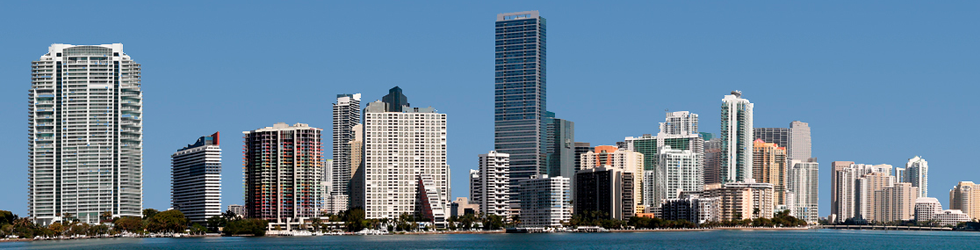







Miami , Florida
City Flag
The city flag of Miami is horizontally tricolored with orange-red, white and green with the city seal in the center.Located in the southeast corner of Florida is the beautiful city called Miami. This city is surrounded by the Miami River, Biscayne Bay, the Everglades and the Atlantic Ocean.
Miami earns the name of being the largest city in the south Florida metropolitan network Miami comprises of the Miami-Dade County, Broward County, and Palm Beach County thus becoming the largest metropolitan region in the Southeastern United States.
Miami’s existence was integrated officially on July 28, 1896. The city held a small population of only 300 at that time. Then the population began to increase gradually and in 1940, it mounted up to 172,172 people. According to the 2000 census the city of Miami had a population of 362,470 while the larger metropolitan area had a population over 5 million.
Thus Miami's population has been continuously increasing owing to the immigrants and migrants who have settled there from the other parts of the country. People regard Miami as a blend of all cultures because of its varied population of ethnic Latin Americans and Caribbean islanders (many of them Spanish- or Haitian Creole-speaking).
Miami is now well known to the world due to its economic and cultural development. This city is also titled as "The Gateway of the Americas." because of its cultural and linguistic ties to North, South, Central America, and the Caribbean. Miami, along with Atlanta, ranks as one of the most important business centers in the Southeastern United States.
History Of Miami
Early History
There are many speculations about the name of the city one such speculation is that the name “Miami” could have been derived from the Native American word for "sweet water." Since the Miami River functioned like a funnel for water from the Everglades to the Atlantic Ocean, the whole region was filled with water. Another assumption is that Miami got its name from the original name of Lake Okeechobee, Mayaimi, which meant "big water" by the natives of that place.
City Seal

After the entry of Europeans, Miami got its name from the lake, and the locals living there were known as the Miami tribe, while the lake's name was eventually replaced with the Miccosukee tribe's words Oka (water) and chobi (big), "big water." But then there is still no proof about the link between the Miami Indian tribes and the southeastern United States, let alone in south Florida.
Native Americans are known to have settled in the Miami region for about 10,000 years. The Tequesta people were living there when the Europeans entered the region. Their life style was simple and they controlled an area covering much of Southeastern Florida including what are now Miami-Dade County, Broward County, and the southern parts of Palm Beach County. But the taquestans and other prehistoric Indians of Florida were demolished by European disease and warfare. Soon the other tribes from all over began to occupy the lands vacated by the taquestans, and many wars were fought to obtain the rights over the region.
Early Growth
Early in the 1920s, the government did not lay any stringent laws or prohibitions, this encouraged people to migrate from the northern United States to the Miami region. As the population began to increase, the city’s economic development also started to flourish well. This lead to a construction boom and many high-rise buildings were built. Some early buildings were destroyed so that a bigger building could be built in its place.
But then there was a slight problem due to building construction delays caused by bulk of building materials overloading the transport system into the area. Sometimes a ship bringing these supplies was stranded due to machinery problem, blocking the port. The investors were in double mind due to these crises. Eventually when the problem could not be solved, the mayor banned on all goods, except the food items. This put a full stop to the economic growth of the city and they received another bang due to the hurricane. The hurricane destroyed the city and the Great Depression followed.
Soon they were able to recover from the depression era. The commercial aviation played an important part in their recovery. A lot of artwork and architecture was also encouraged.
The Cuban refugees began to migrate to Miami and they started their own businesses including restaurants, garment companies, furniture stores etc. and their impact on the city’s economy was very vivid.
Geography And Climate
Geography
The City of Miami and its fringes are located on a broad plain between the Florida Everglades and Biscayne Bay that also extends from Florida Bay north to Lake Okeechobee. This region holds a maximum height of 15ft (4.5m) and averages at around 3ft (0.91m) above sea level in most neighborhoods especially near the coast. The main portion of the city lies on the shores of Biscayne Bay, which contains several hundred natural and artificially created barrier islands, the largest of which contains the city of Miami Beach and its famous South Beach district. Since The Gulf Stream, a warm ocean current, runs northward just 15 miles (24.1km) off the coast, the city has a warm and serene climate all through the year.
Miami oolite or Miami limestone form the surface bedrock. A 15 m thin layer of soil covers the bedrock... Miami limestone formed as the result of the drastic changes in sea level associated with recent glaciations or ice ages. The sea levels were raised to approximately 25 ft above the current level due to the Sangamon interglacial. A shallow sea covered all of southern Florida. Along the Dry Tortugas and the submerged Florida plateau ran parallel lines of reef. The deposits of oolites and the shells of bryozoans present in the lagoon behind the reef line formed the Miami limestone. Wisconsin glaciations began lowering the sea levels around 100,000 years bask, thus the floor of the lagoon got exposed. But then the sea level dropped to 300 to 350 feet by 15,000 years, it dropped below the current level. And then the sea level began to rise up quickly after that, thus around 4000 years ago it achieved a stabilized current level, so the mainland of South Florida existed just above the sea level.
Biscayne Aquifer is a natural underground river that extends from southern Palm Beach County to Florida Bay, with its highest point peaking around the cities of Miami Springs and Hialeah. This Aquifer provides the south Florida region with drinking water. It becomes impossible to dig more than 15 ft below the ground level due to the presence of aquifer, this perturbs underground construction.
The Everglades is a subtropical marshland positioned in the southern portion of the U.S. state of Florida. Some times alligators and crocodiles venture into this area and give problems.
In terms of land area, the city of Miami is one of the smallest major cities in the United States. According to the US Census Bureau, the city encompasses a total area of 55.27 mi² (143.15 sq. km). Of that area, 35.67 sq. miles (92.68 sq. km) are land and 19.59 sq. miles (50.73 sq. km) are water. Miami is slightly smaller in land area than San Francisco and Boston. The city is located at 25°47'16?N, 80°13'27?WGR1.
Climate
The city of Miami presents its inhabitants with pleasant weather, the summers appear to be warm and enduring while the winter is little frosty. The region does not posses a moderate climate; instead it is divided into a wet and dry. Where one can experience dry season during the winter and wet rains during summer.
The Gulf Stream is responsible for the warm climate all year around. A typical summer day does not see temperatures below 70ºF (21º C). As the morning progress, humidity build as water evaporates culminating in near-daily afternoon showers settling into a humid evening and cool night. Humidity is much less during winter. Cold fronts that dip down from the northern states generally moderate temperatures; average temperatures are around 60ºF (15ºC) and lower depending on whether there is a cold front and rarely dip below 40ºF (4ºC). During the dry season, the Gulf Stream keeps the cold fronts from badly affecting Miami as they do in more northern areas of the state of Florida.
Officially, Miami's warmest recorded temperature was 103ºF (39.4ºC) on July 17, 2004,). The coldest recorded temperature in the city of Miami was 27 °F (-2.8 °C) on February 3, 1917, though the coldest temperature ever recorded in the metropolitan area was 20 °F (-6.6 °C) near Homestead, Florida, on January 19, 1977. Miami also experienced its first and only recorded snowfall on the same day.
Hurricane season officially runs from June 1 through November 30. The most likely time for the hurricane to occur is during the peak of the Cape Verde season, which is late August through the end of September. Miami is the most likely city to be hit by a hurricane due to its position between two large water bodies. The city is lucky enough by not experiencing a direct hit by a hurricane since 1950's Hurricane King, although many other hurricanes have affected the city, including Hurricane Cleo in 1964, Betsy in 1965, Andrew in 1992, Irene in 1999, and Hurricanes Katrina and Wilma in 2005. In October of 2000, the city experienced record rainfall and flooding when a tropical depression passed over the city. The storm was referred as the No Name Storm of 2000, but it obtained the name Tropical Storm Leslie, when the depression entered the Atlantic Ocean.
Economy
Including American Airlines, several multinational companies like Cisco, Disney, Exxon, FedEx, Microsoft, Oracle, SBC Communications and Sony have their headquarters of Latin American operations in Miami. This is due to the immediacy of Miami to Latin America. Several large companies are headquartered in or around Miami, including Alienware, Autonation Burger King, Citrix Systems, DHL, Norwegian Cruise Line, and Ryder System. Miami International Airport. The Miami port now stands to be the busiest port in the world. A lot of international banks are situated in and around Miami. Miami also the hosted the 2003 Free Trade Area of the Americas negotiations, and is one of the leading candidates to become the trading bloc's headquarters.
Tourism is a flourishing industry in Miami: the beaches of Greater Miami
attracts people from all over the world and the Art Deco nightclub district
in South Beach (located in Miami Beach) is considered to be one of the
most enchanting place in the world. However, it is important to note that
Miami Beach is not a part of the city of Miami.
In addition to these roles, Miami is also an industrial center, especially
for stone quarrying and warehousing.
A lot of legendary legal proceedings have taken place in Miami. The most important case being the most notable $145 Billion verdict leveled against the nation's 5 largest cigarette companies. The case was on behalf of all badly affected Florida smokers and their families. These affected families were represented by a well-known and successful husband and wife legal team, Stanley and Susan Rosenblatt, who were raised in Miami
U.S. Census Bureau 2002 American Community Survey reported that Miami was the poorest city in the United States, because 31% of the populace had earnings below the national poverty line. But in 2004, Miami was pushed back to #3 in the rankings after Detroit, Michigan and El Paso, Texas.
Miami is considered to be a very expensive place to live in, because 69% of their populations spend at least 30% of their family income on home possession.
There has been a largest real estate boom since the 1920s.
People And Culture
Demographics
According to the United States population listing Miami holds the 46th place. The census recorded at 2000 reported that there was 362,470 people living in Miami, thus Miami turns out to be one of the most thickly populated cities in the country. According to the census there are 66.62% White, 22.31% African American, 0.22% Native American, 0.66% Asian, 0.04% Pacific Islander, 5.42% from other races.65.76% of the populations are Latino of any race. 11.83% of the populations are non-Hispanic whites. Miami is also known for the fact that its residents are from a mixture of races.
There are homes containing 26.3% of children under the age of 18. There are 36% of married couples and 18% of single females running a family.
And there are also a meager percentage of elderly persons living alone.
This city also has some percentage of youngsters and elders living below the poverty line. For every 100 females there are 98.9 males. For every 100 females age 18 and over, there are 97.3 males. The FBI's Uniform Crime Reports Program ranks Miami as the second in the survey of most dangerous cities in United States due to increase in crime rate.
Miami also contains a set of population who has not graduated. The official language in Miami is English, Spanish, and Haitian Creole. Afrikaans, Brazilian Portuguese, French, German, Hebrew, Italian, and Russian are the other languages spoken by the residents of Miami.
Area Attractions
- Downtown Miami at night Barnacle Historic State Park
- Bayside Marketplace
- Biscayne National Park
- Coconut Grove
- Coral Castle
- Deering Estate
- Everglades National Park
- Fairchild Tropical Gardens
- Fruit & Spice Park
- Jerry Herman Ring Theatre
- Little Havana
- Miami Metro Zoo
- Miami Museum of Science and Planetarium
- Miami Seaquarium
- Monkey Jungle
- Parrot Jungle Island